As mentioned in the last issue of our newsletter ( https://answernepal.org/mass-protests-erupt-in-nepal-over-government-corruption/ ) , The Generation Z Revolt of September 8-9 in Nepal seems to be part of an expanding global movement toward democratic order, especially in Asia (vis-à-vis the populist movements in the West). Because these protests mirror the youth-led, pro-democratic “Arab Spring” protests (2010) of the previous generation, they have been collectively labeled the “Asia Spring” movement. Moreover, address anti-corruption and favoritism and seem to erupt spontaneously, spreading like wildfire within and between countries via cell phone communication. Among those countries hit are Sri Lanka (2022), Bangladesh (2024), Nepal (Sept 8-9, 2025), Philippines (mid-Sept), and Timor-Leste (Sept 15-17). Although technically not in Asia, Madagascar is another island country in the Indian Ocean like Timor, which was hit with its own Gen Z protest just a week later (Sept 25, 2025). That’s 4 revolts in less than 3 weeks!
In light of this, one has to ask, “What lasting influence did Arab Spring have on the Mideast and what does this portend for Asia Spring countries like Nepal?” For the most part, unfortunately, we have seen these Arab Spring movements fall short of their democratic goals—of the Arab states involved, only Tunisia successfully transmuted to a democracy. Egypt, Libya, Yemen, Syria, Lebanon, Bahrain, etc. are for the most part still monarchies or dictatorships, even if the governments were initially overturned. Unlike the Arab World, Asia is not entirely Islamic. Cultures make a big difference—just ask Martin Luther!
The road to democracy, it seems, is peppered with potholes that need to be backfilled before real progression can begin. When it comes to filling the potholes, Gen Z in Nepal has created even bigger potholes reminiscent of the US Army’ “good intentions” in Vietnam, “We had to destroy the village in order to save it!” On the second day of the protest, Oct 9, as a reaction to the killing on the street by the Armed Police (including a 12 y.o. school boy bystander who was shot in the head), the protest turned to violence and rioting, resulting in 75 civilian deaths (3 of whom were policemen) and approx. 2500 injuries.
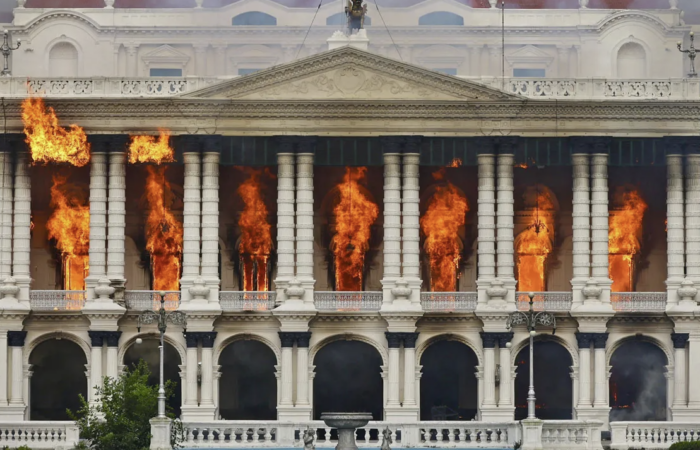
Of all popular movements, the destruction done by Gen Z Nepal is said to be one of the worst of all time. In a single day, the Parliament Building, the Supreme Court, the Gen Attorney’s office, some 300 govt offices across Nepal (including Singha Durbar in Kathmandu), as well as the palatial homes and offices of the PM and President and many party leaders, were attacked, burned or heavily damaged. The damage to Nepal’s infrastructure is estimated to be around $7 billion, or about half Nepal’s GDP! Yet, the financial loss to the private sector is thought to be twice this amount, and includes two torched and heavily damaged 5-star hotels in Kathmandu (the Hyatt Regency and the newly completed Hilton) as well as Nepal’s largest private outlet Kantipur Media House.
However, when it comes to popular uprisings, Nepal has accomplished more than most. Overnight, the social media ban, which prompted the uprising, was immediately lifted. The PM resigned and within a few days thereafter, a new PM (former Chief Justice of the Supreme Court) was selected and appointed by the President (responding to popular demand expressed on a social media platform “Discord”). The lower house of Parliament was dissolved, and the imposed curfew was lifted in Kathmandu. To put the first week in a nutshell, here is a chronology of events of the week of the revolt:
Early SEPT Govt bans social media platforms (unregistered). (Discord was already registered).
SEPT 8 Gen Z Protest over the banning of Social Media/Corruption
SEPT 9 Gen Z Protest in reaction to Police Killings: Burning of Parliament, Govt bldgs. & residences (not to mention a couple of 5star hotels). PM Oli resigns and receives Army protection
SEPT 10-13 Social Media Ban lifted Curfew Instituted. Peace restored and maintained by Army
SEPT 12 President Sigdel Paudel appts Sharmila Karki as interim PM
SEPT 14 Pres Paudel carries out the dissolution of the Lower House of Parliament with elections TBA
Late SEPT Curfew is lifted in the Kathmandu Valley
It is far too soon to gauge whether Gen Z will be successful in doing away with government corruption in the long run. I am reminded of Ben Franklin’s famous remark upon leaving the Constitutional Convention as to what kind of government was created. “A republic. If you can keep it.” That is where we sit today.
Nepal, it seems, is going to retain its decade-old Constitution (ratified Sept 20, 2015), but institute new elections on March 15. This Constitution, however, has the President appoint the PM with parliamentary approval, and the big push now for Gen Z is to have the new PM be directly elected by the People which presumably would mean amending the constitution. Meanwhile, rival groups and individuals within and without Gen Z are jockeying for power while the main (but corrupt) parties are in crisis mode trying to restore their standings.
March 15 is just 5 months away, but with the high range of uncertainty and volatility in the political AND social spheres today, anything can happen. New leaders are emerging, old leaders are stepping down. For this reason, I quote from, an insightful article from a young Nepali physics student Piyush Adhikari that appeared in Al Jazeera Oct 3. I encourage all of you to click on this link and read the rest of this short, enlightening, and uplifting piece. (https://www.aljazeera.com/opinions/2025/10/3/nepals-leaderless-gen-z-revolution-has-changed-the-rules-of-power).
 “In the 48 hours that Nepal’s Gen-Z revolution unfolded, one question echoed across the country: “Where is their Lenin [leader]?” But perhaps that question missed the point. For decades, every Nepali revolution has been undone not by its enemies but by those who claimed to lead it. This time, the absence of a single figurehead was not a weakness; it was the movement’s greatest strength. [my italics]
When the protests subsided, one name began to circulate: Sudan Gurung, head of the youth-led Hami Nepal [loosely, “We are Nepal”]. But Gurung did not lead the uprising; he emerged only after it was over, more as a spokesperson than a commander. His late prominence was proof of what made this revolt different. By refusing to anoint a leader, Nepal’s young protesters broke with a past where power was always concentrated in the hands of a few. They showed that change could emerge from the collective rather than the charismatic.”
Piyush concludes, “The lesson of September is that our only hope is ourselves…. Accountability must become part of Nepal’s civic DNA to ensure a vigilant, organized and awake citizenry…The power must remain where it was discovered: With the people.”
To read these remarks coming from a Nepali student (presumably of Brahmin background) shows me that positive change in the world is happening; and as in Nepal, it is young people (Generation Z, those in High School and college), the very ones we have been educating. Sudan Gurung of Hami Nepal, one of the emerging young Gen Z leaders, is just 36 years old. He is the founder and coordinator of an NGO which provides disaster relief in Nepal. The mayor of Kathmandu, Balen Shah, is a young man (35 years old) who was a rapper and a civil engineer before he was elected mayor and has since gained popular support for his anti-corruption and transparency stances. Remarkably, he was elected as an independent and, like Sudan Gurung, has no party affiliation. They represent a new wave of political leaders who may be coming in if the Gen Z tsunami washes clean.
All this, despite the odds, gives real hope for real change in Nepal. It also shows how ANSWER has been on the cutting edge of this change. If change is to come, the new leaders of these changes are going to come from somewhere, and our students represent the vanguard for these democratic reforms. Now, as I approach “80-hood” and am witnessing these events, I don’t simply feel proud, but gratitude… to all of you for stepping up and being a part in bringing new leadership to a nation impoverished by caste, injustice, and corruption. You are the ones who should feel proud! Whether Gen Z will be any more successful than previous generation is yet to be realized, but there is no question that they know where and how to get there.