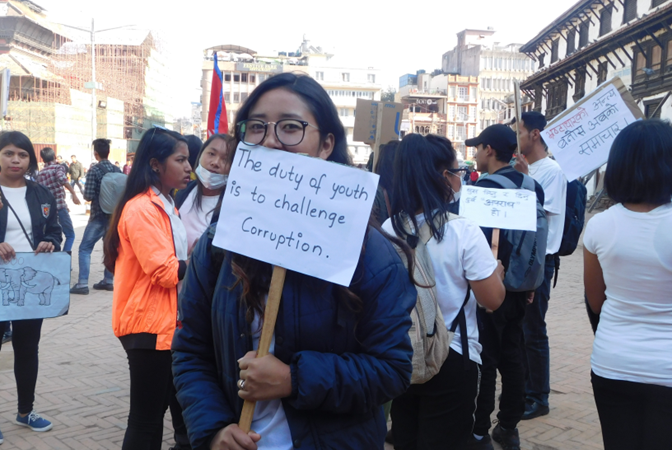
The mass protests over government corruption, especially against wealthy politicians, has taken me totally by surprise because Nepalis have been living with it for decades. When I ask our ANSWER staff, “Doesn’t it bother you that we have to provide lunches and cover other “fees” just to get recertified?” They shrug it off with “Ke garne?” What to do? And it is no wonder: the 10-year Maoist insurrection of the 1990s was supported precisely because people believed the Maoists were going to eliminate corruption, along with wealth and land disparities. They didn’t! While they did succeed in molding a secular republic and writing a new constitution, the Maoists bought in the “power–brings–riches mentality” of the old guard. Since then, the 601-member parliament has honed the art of buying and selling influence under the table. Corruption pervades every level of society—cities, towns, villages, and many, if not most organizations. Nepal is widely recognized as one of the most corrupt countries in the world!
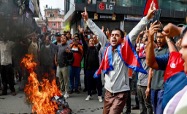
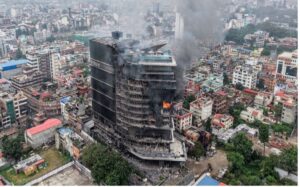 Now, at last, the youth of Nepal (Gen Z) are doing something about it…unfortunately rioting ensued, many young people were killed; magnificent government buildings, luxury hotels, and homes of the wealthy were burnt to the ground; jails all over the country were targeted allowing 15,000 prisoners to escape, and a number of Ministers of Parliament (MPs) and their family members were thrashed by mobs. Damage to infrastructure could run as high as a billion dollars!
To follow all this and make sense of it has been difficult. Our office is closed in Kathmandu, internet access intermittent, and our last email from Bal (in-country director) stated in his one and only email to us on September 9 that our staff are safe. My usual news source in Nepal is the English newspaper The Kathmandu Post, but its website is down. I did find that the state-run newspaper Republica is still up, and that’s been a help. But, the saving grace belongs to our two “crack reporters” who have really, truly been a godsend. Thanks to Jane, a sponsor in Colorado who keeps sending me valuable news links, and Subhanjal, an ANSWER college student who wrote a long, descriptive, and chronologically arranged email to his sponsor in Argentina! I might add, that one can now find excellent videos on YouTube:
Why Gen Z?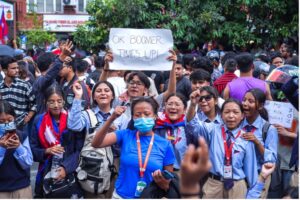
Generation Z (also called “Zoomers”) are the young people born between 1996 and 2012 who have grown up entirely in the “ubiquitous digital age.” Most are in their 20s. In Nepal, many Zoomers are living abroad, studying, but more likely, working as migrant laborers, choosing not to be unemployed like the 20% of their cohort who remain in Nepal! Some of those who work abroad, were taken in by the good pay and were recruited as Russian mercenaries on the front lines in Ukraine—some are now returning to Nepal in a box!
Surprisingly, the Nepali government has encouraged and “facilitated” exporting their native sons abroad rather than developing industries and growing employment in Nepal because the remittances sent home to support their families are taxed upon entry. This has left many villages almost devoid of men while women and children maintain their small farms which yield few or any taxes. So, huge sums (amounting to ~1/3 of the national budget) are collected through these remittances, which reduces the burden on the rich. Meanwhile, wealthy and powerful MPs are able to muster good jobs and incomes for themselves and pass it onto their children through corruption, viz., nepotism (the youth of the rich are resentfully referred to in Nepal as “Nepos”).
I compare these “Gen Z Protests” to the 2010 “Arab Spring Protests” which were mostly organized by Gen Y (aka, the Millennials) at that time and coordinated by use of their cell phones. Subhanjal, however, rightly compares the Gen Z Protest to a similar, slightly earlier (2006) Nepali democratic protest called Jana Andolan II (lit. “The Second People’s Movement”) in which the monarchy was replaced with a Prime Minister and a democratically elected parliament. Subhanjal states that at that time “only 21 people were killed over 19 days” For the sake of comparison, Subhanjal points out with the Gen Z Protest “18 people were killed in one day!” The death toll as of today (9/12) has risen to 51.
How did this come to a head?
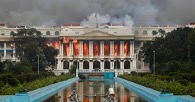 With the growing discontent (and that most young people in Nepal today have smart phones), Gen Z began posting their discontent and frustration on social media for all to see…which spread and multiplied. Then, a few days before the riots broke out, someone posted a video #nepobabies of the children of the wealthy politicians flaunting their wealth (cars, watches) and luxurious lifestyles…and that went viral, incensing the public and evoking demonstrations. The political response to this was a total social media ban (under the pretext that a few of these companies had not paid their registration fee). The anti-corruption movement expanded to include free speech, and Gen Z took to the streets and rioted. The police (or army) trying to quell the mobs, shot and killed people (using real bullets instead of rubber bullets), Gen Z and their supporters went into a rage, burning buildings, etc. Two days later peace was restored (for the time being), the Army under General Ashok Raj Sigdel is now in control, and the principals are talking.
What Now?
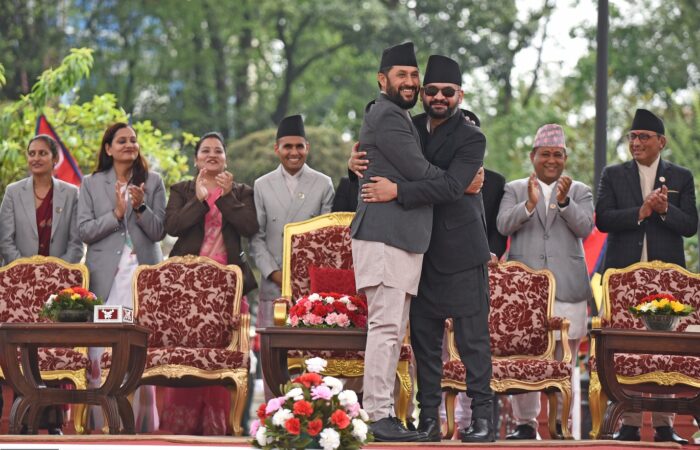
Gen Z (includes many groups but is without any single leader) has rightly rejected the idea of the former Prime Minister stepping in, pointing out that all parties are corrupt and no government official is to have a position of power. There are, however several “proven candidates” to head the interim government are being considered as they have no party affiliation. Sushila Karki, a former Supreme Court Justice who rendered sound decisions on some important cases and Balendra (or “Balen”) Shah, a former rap star and engineer who, as an independent candidate, was elected as mayor of Kathmandu. Mayor “Balen” has thrown his support over to Sushila Karki. However, just this morning I read that General Sigdel was in favor of installing the former king Gyanendra! This elicited immediate warnings of a throwback to the old parties under the old constitution, and again Gen Z took to the streets. The President of Nepal Ram Chandra Paudel (the constitution includes both a President and a Prime Minister) then relented on his constitutionally based objections and has just sworn in the former Chief Justice Sushila Karki as the acting Prime Minister!
The Bright Side
Subhanjal, in his long email, summed it all up: “Although the protest caused deaths and destruction, one positive thing is that new politicians shall now value individual lives more. Previously, under [Prime Minister] K.P. Oli, even small protests led to deaths. The old leaders used to block new leaders, becoming arrogant, but now there is a chance for change and new leaders to emerge.”
What Next?
 This is anyone’s guess. The fact that the Prime Minister resigned (and fled abroad), that the President ignored the constitutional mandate against a former supreme court justice for holding this office and swore in Sushila Karki, and that the head of the Army backed down from his support of the former King bodes well. However, some groups within Gen Z have voiced objections to PM Sushila Karki’s pro-India leanings, many conservative Nepali Hindus still back the King, the constitution is still in place, the former MPs are still wealthy and could have an axe to grind and make things difficult. India has always had a penchant to meddle in the internal affairs of Nepal, as they did with their embargo of Nepal in 2015 when Nepal desperately needed help from abroad after the earthquake.
What does this mean for you and ANSWER?
My sympathies to all those who are wondering what to do? As much as I wanted to return to Nepal this Fall, I balked when my 19 y.o. dog Puppy stopped eating and drinking for 2½ days last month. She’s eating and drinking, and doing shorter walks now, but she is having a rough go of it. So, I am on hold until Spring 2026. Please feel free to contact me or Lisa if you have any questions.
Earle
PS. One of our contacts in Nepal just wrote to us with this update:
“[T]he parliament has been dissolved and Ex Chief Justice Sushila Karki has been appointed as the new interim prime minister of Nepal. And, the elections are scheduled for Falgun 21, 2082 ( 5 March, 2026). Although, there have been disputes regarding it as well but we are relieved that the prime minister has been appointed without much delay. We are hoping for stability and peace along with better leaders to come forward in the future.”